Pre-ORDER Ships November 2026: Titanium Moka Pot The Last One You Will Buy · 250ml · 4 Cups · 415g
Pre-ORDER Ships November 2026: Titanium Moka Pot The Last One You Will Buy · 250ml · 4 Cups · 415g
Couldn't load pickup availability
Preorder. Ships out November 2026. Your unit from the first run ships with a spare silicone gasket in the box.
The Last One
One Moka Pot. Twenty Years of Mornings. No Decision After This One.
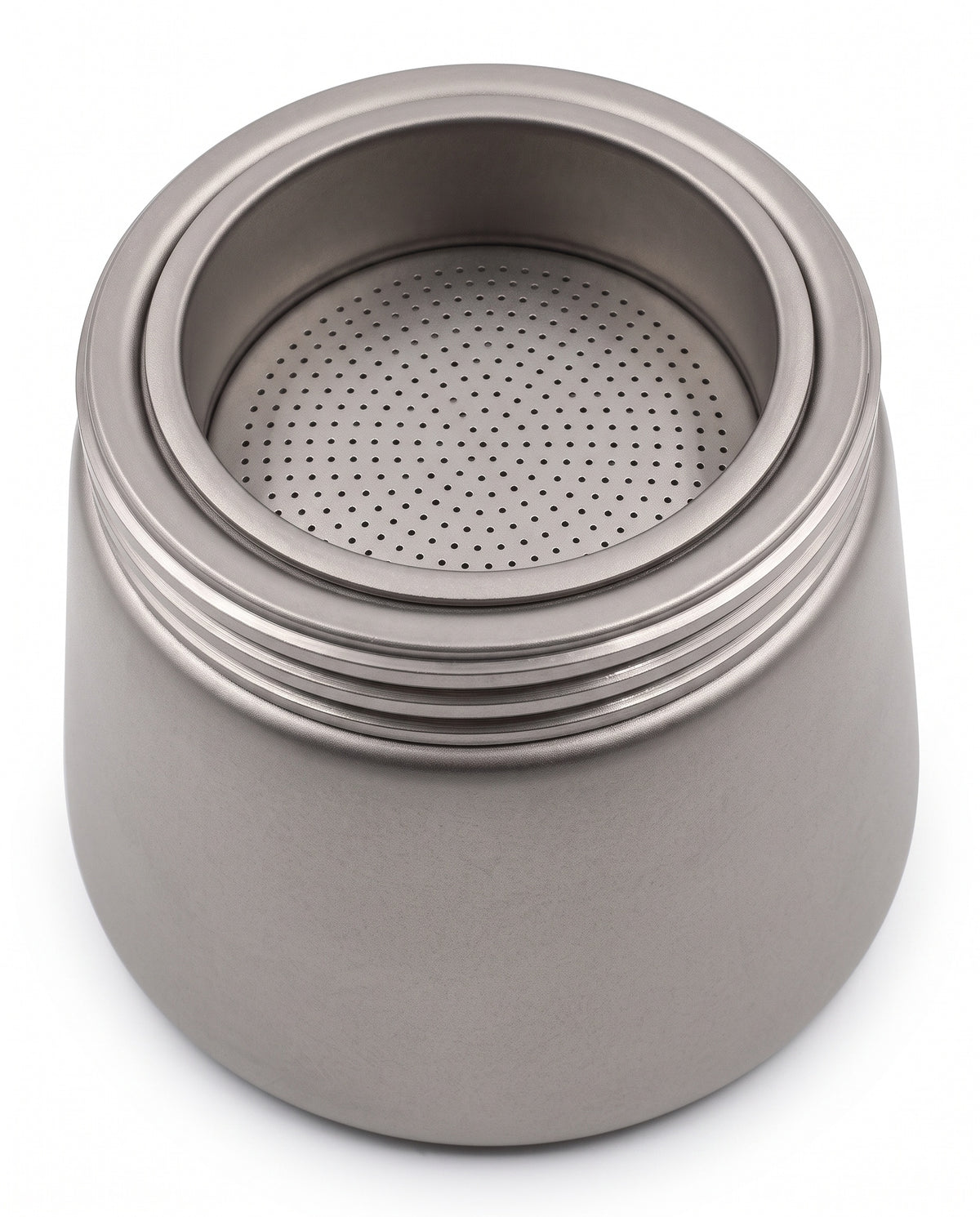
You have replaced the aluminum one before. The interior went chalky, the gasket set into its seat, the handle softened over the flame, and the pot went back on the list of things you would deal with eventually. This one comes off the list. Every surface the coffee touches is Grade 1 titanium: boiler, funnel, filter plate, upper chamber. No coating to wear through. No liner. No aluminum. The whole consumable list is one silicone gasket, and you change it with your thumbs. Bead-blasted titanium and dark walnut, with no printed mark anywhere on it. It reads as plain to people who do not know, and as exactly what it is to people who do.

Why It Is Terminal
There Is No Better Version to Upgrade To
Grade 1 is commercially pure titanium, and it forms a stable oxide film. It is uncoated, nickel-free, and PFAS-free, so there is nothing between hot water at pressure and bare titanium. Most titanium moka pots still drop a stainless mesh into the water path. This one does not. Aluminum pots depend on a thin oxide skin or a liner to keep raw metal out of the cup. Here there is nothing to keep out, and nothing that gets worse with use.
Filled to just below the safety valve. Yields about 200 ml of brewed coffee, four espresso cups or two small cups.
14.6 oz assembled, 6.6 in tall on a 4.2 in base. Made for a kitchen counter, not a backpack.
No nonstick, no anodizing, no liner, no paint. Bare titanium inside and out, for the life of the pot.
Note: titanium moves heat more slowly than the aluminum most moka pots are made from, so heat stays concentrated where the flame touches. That is a real tradeoff and it changes how you brew. This pot wants a small flame centered under the base and a hot water start. That happens to be exactly how good moka coffee has always been made, but if you are used to running a moka pot on a wide-open burner, this one will tell you about it.
Before the Day Has an Opinion
The Only Twenty Minutes That Are Yours
Nine in the morning is spoken for. So is one, and four, and seven. Somewhere before all of that there is a window nobody has reached yet. A moka pot fills it properly because your judgment is a required input: the grind, the fill, the small flame, the honey-colored stream you pull at the right second. The brew itself takes two to four minutes. The part that does the work is the seven minutes you sit down with the cup, and the pot is the reason you agreed to sit down.
Built for a Serious Kitchen
It Does Not Look Like Equipment
Matte bead-blasted body, one bright satin collar where the chambers thread together, a hinged lid with a walnut knob, a walnut grip on a bare titanium bracket. One brass safety valve on the boiler wall, and that is the only other color on it. Nothing printed, nothing etched, nothing to explain to a guest. It sits on honed stone next to good knives and belongs there. Aluminum pots dull and pit. Titanium takes on a faint patina where the flame touches and otherwise looks in year twenty the way it looked on the day it arrived.

About 200 ml, poured. Then the seven minutes nobody schedules.
Stated Accurately
Twenty Minutes, Honestly Accounted For
The brew is short. The window around it is the point. Here is where the time actually goes.
| 0 to 3 min | Grind 18 to 20 g, medium-fine. Coarser than a pump machine wants, finer than drip. |
| 3 to 5 min | Kettle water just off the boil into the boiler, to just under the valve. Coffee into the funnel, leveled with a finger, never tamped. Thread it shut. |
| 5 to 9 min | Small flame, centered. Two to four minutes to the first murmur. Nothing to do here. That is the point. |
| 9 to 10 min | Lid open. Watch it rise, pull it at the honey stage before it goes pale and starts to sputter. |
| 10 to 12 min | Pour. About 200 ml, four small cups or two cups. |
| 12 to 19 min | Sit down and drink it. No phone, no inbox. This is the part that does the work, and it is the part everyone skips. |
| 19 to 20 min | Rinse, dry, set it back. |
How It Is Meant to Be Run
Almost Every Bitter Moka Coffee Is a Heat Problem
Steam pressure in the boiler, only about 1 to 1.5 bar, pushes hot water up through the coffee. Gentle heat moves it through slowly and evenly and gives you a sweet, heavy, syrupy cup. Too much heat rushes the water through and then blasts steam through the spent grounds at the end. That is the burnt, metallic cup people blame on the pot. Five habits fix it permanently.
Boil a kettle, fill the boiler with water just off the boil. The pot spends two to three minutes on the stove instead of ten, so nothing bakes.
Water must never cover or block the brass safety valve. It is the overpressure escape and it needs air above the waterline.
18 to 20 g, medium-fine grind, filled loose to the rim, tapped to settle, swept level. Never tamped, never mounded, never a half dose.
Flame tips stay inside the base footprint. You want a slow honey-colored stream you can watch, not a violent sputter you can hear.
The second the stream goes pale and starts to gurgle, off the heat and close the lid. Run the boiler under a cold tap and extraction stops on a dime.

Lid open, brew running. A slow honey-colored ribbon means the heat is right. When it goes pale and starts to sputter, the brew is over. Full method is in the brewing and care booklet.
Where the Others Fail
Every Moka Pot Fails Somewhere. This Is Where.
A moka pot is five parts and a pressure vessel. Work out where the aluminum one dies and you know what you are actually paying for here.
| Part | What usually fails | This pot |
|---|---|---|
| Body material | Aluminum pits, oxidises chalky, and adds a raw metal edge to the cup | Grade 1 titanium throughout the water path. Inert, no metal taste |
| Interior finish | Nonstick and anodized liners wear through, then you are drinking the substrate | No liner and no coating exists to wear through |
| Handle | Moulded plastic softens and cracks over the flame and is not replaceable | Walnut on a titanium bracket, off in thirty seconds with one knurled screw |
| Filter plate | Fixed in place, so the perforations clog with rancid oil you cannot reach | Lifts out with a spoon handle. Wash it, clear it, press it back |
| Gasket | Hardens into its seat, and on discontinued pots you cannot buy another | Still a wear part, roughly 6 to 12 months on daily use. Spares stocked at valtcan.com |
| Cleaning | "Never use soap" advice, because soap strips the seasoning off the coating | Wash it properly with mild dish soap. Nothing to strip |
In the Box
Six Parts. Every One of Them Serviceable.

- Titanium upper chamber with hinged lid, wood knob and pour spout
- Titanium boiler with brass safety valve
- Titanium funnel, the coffee basket that seats in the boiler
- Titanium filter plate, the perforated disc in the underside of the upper chamber
- Food-grade silicone gasket
- Detachable wood handle with knurled locking screw
- Drawstring carry bag
- Brewing and care booklet
The handle ships detached so nothing bends in transit. Attaching it takes about thirty seconds and no tools.
Service Life
The Only Part That Wears Out Costs Less Than a Bag of Beans
Flip the upper chamber over and the whole maintenance story is right there: a perforated titanium filter plate and a silicone gasket, both of which pop out with a spoon handle. Wash them, clear the perforations, press them back in with the grooved side of the gasket facing up. Inspect the gasket monthly and replace it when it hardens or the seam starts to weep, roughly every 6 to 12 months if you brew daily. That is the entire consumable list for this pot.

Specifications
The Numbers
| Material | Grade 1 commercially pure titanium: boiler, upper chamber, funnel, filter plate. No coatings, no liners |
| Boiler capacity | 250 ml, filled to just below the safety valve |
| Brewed yield | About 200 ml, roughly 4 espresso cups or 2 small mugs |
| Height | 6.6 in (166.9 mm) |
| Base diameter | 4.2 in (106 mm) |
| Weight | 415 g (14.6 oz) |
| Dose | 18 to 20 g, one full level basket. Medium-fine grind, between espresso and drip |
| Safety valve | Brass, boiler-mounted |
| Gasket | Food-grade silicone, replaceable by hand. Spares available at valtcan.com |
| Handle | Detachable wood handle on a titanium bracket with knurled locking screw. Wood lid knob |
| Heat sources | Gas, electric coil and glass top. Induction requires a steel adapter plate |
| Assembly | Hand-tight only, no tools |
| Care | Hand wash with mild dish soap. Not for the dishwasher, because of the wood handle and knob |
| Branding | Bare metal. No paint, no printed logos |

The brass safety valve stays sealed through a normal brew. If it ever hisses, the bed is choked: take the pot off the heat, let it cool completely, and go a step coarser next time.
Preorder. Ships out November 2026. Your unit from the first run ships with a spare silicone gasket in the box.
FAQ
Questions, Answered Straight
Is this a camping pot?
Is titanium actually better, or just different?
You said titanium conducts heat more slowly. Does that hurt the coffee?
Does it make real espresso?
How much coffee does it make?
Will it work on my induction cooktop?
The bottom will change color. Is that damage?
How often do I replace the gasket, and can I still get one in ten years?
Can it go in the dishwasher?
Do I need to season it before the first cup?
When exactly does my preorder ship?
Titanium does not have a service life. There is no coating to wear through, no liner to fracture, no metal to pit, and nothing inside this pot that gets worse with use. Wash it properly, replace a gasket now and then, and it outlasts the stove you set it on. Someone will inherit this.